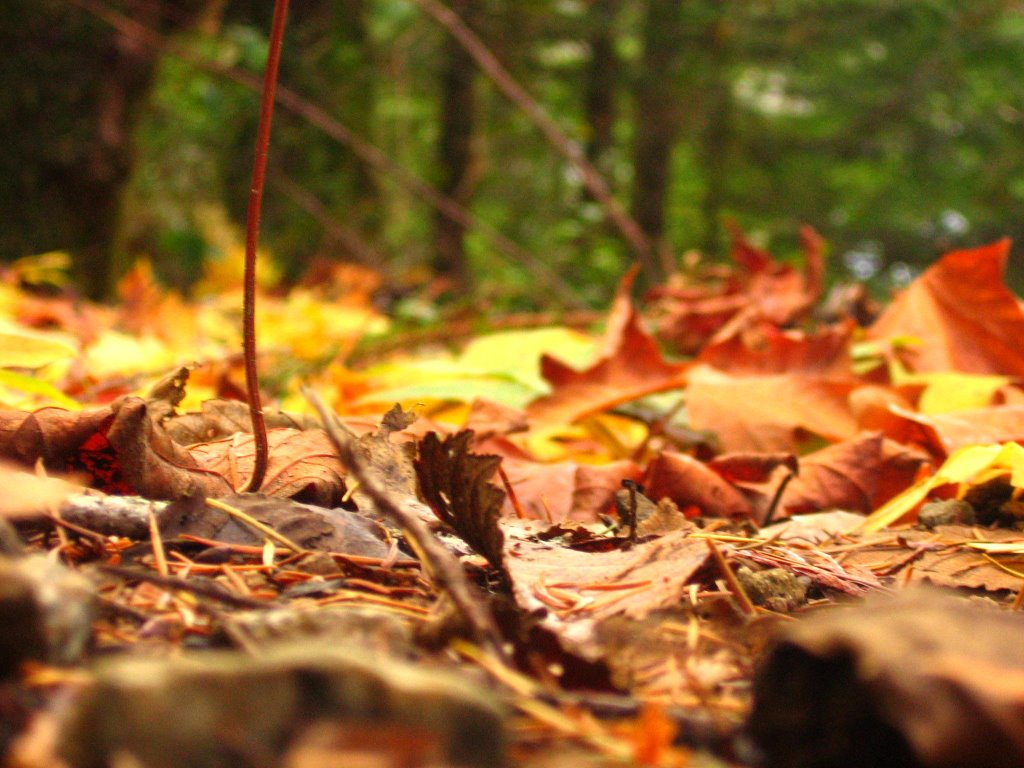
Sunday, October 29, 2006

Maybe I will name my first child "Aurelia"

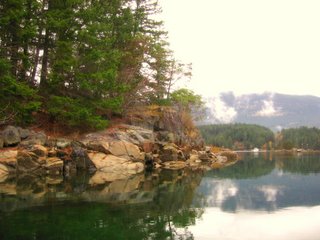
Well, I didn’t find a lot of sunshine on the Sunshine Coast, but I found plenty of other experiences to satisfy me. I had my fill of theological conversation on the car ride there. Upon arriving, I walked a winding path to the top of a hill and spent half and hour watching a red-breasted sapsucker. (A bird.) I learned how to play Rook and lost badly, but was entertained all the while by the trash-talking between my three fellow Canadian card players, Dan, James and Alley. I stayed in a yellow room, looked out at a red Japanese maple tree and navigated deep green waters in a white canoe. I shared tons of laughter and stories and Scripture reading and delicious meals and wine in a hot tub with nine other Regent students. I watched leaves fall. I played the piano for fun. I read a book. I drank hot chocolate with ice cream in it while staring up at shooting stars and listening to Sarah quote G.M. Hopkins.
I think the best part was the water. As I said, it looked forest green, probably because of the reflection off the evergreen-covered mountains. Color alone gave it an aura of mystery, but it had many more secrets. Soon after arriving, Leanne and I set off in a canoe. Only a couple minutes into our trek, Leanne let out a gasp. I followed her gaze over the side of the canoe, and was so astonished and excited I nearly fell in. Aurelia aurita! (Translation: the moon jelly, or common jellyfish.) There was nothing common about them as I saw them for the first time in the wild! The moment was dream-like and surreal; there must have been twenty of them around the canoe, at different depths, all slowly rising. About the size of dinner plates, they seemed to glow fluorescent pink in the dark water, especially the horseshoe-shaped gonads and the peripheral pink fringe, which reminded me of the gathered bottom of window blinds. The glow came from the whole animal, eerily… how can something transparent glow? Upside-down was my favorite view. Its four translucent oral arms drifted lazily in a spiral, and in the center, a strangely lovely ribboned cluster fringed with white light seemed to be the treasure it was protecting under its bell, the secret location of its radiance… (I found these pictures online – I couldn’t take any satisfactory photos of my own!)
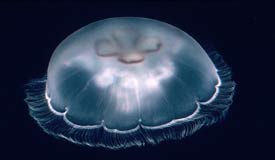
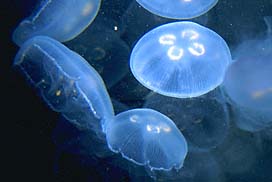
As I observed this beautiful undersea suspended animation, I remembered my only other experience with Aurelia, examining one in a glass dish in Bio 203 (have you done Cnidaria yet, Terice?), turning the dead gelatinous mass (haha, Strongbad) with my tweezers and trying to imagine what it would look like alive in the ocean. My imagination wasn’t near as wonderful as the reality. The process of watching is half the fun. It starts out as a gauzy outline, playing with your depth perception, causing you to look twice – was that just the watery reflection of a small cloud? No, it’s moving!…in slow but determined spurts, rising into greater clarity, growing brighter and larger, sometimes drifting, open and careless, its fringe of tiny hairs floating listlessly, before its muscles contract and it resumes its pulsing motion. It seemed to be deciding where and when to move, which parts of itself to reveal to me, even though it had no brain. (What is it with me and these brainless ocean creatures?) As we circled and circled in our canoe, more and more Aurelia surfaced in this surreal, enthralling way. The scientist in me tried to memorize what it looked like at every angle, tried to remember what all the parts were called. The child in me knew that the water was enchanted, and I was seeing pure magic, whose depth only an ocean-deprived prairie girl could fully appreciate. I am thankful that Leanne shared my delight.
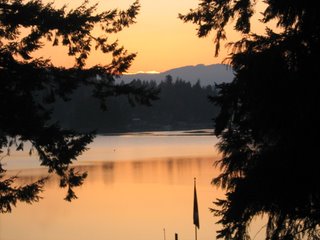
The next morning, I sat on the dock for two hours, stalking the water, trying to see past the surface reflection. I saw many more moon jellies, and my breath caught in my throat every time. At times I would see tiny flashes of light erupt randomly all through the water, which reminded me of the very artificial “sparkle” effect they used to put in movies after something magical happened, like someone disappearing. When my eyes adjusted, I realized it was a school of small fish, with scales catching the sunlight when they happened to be at the right angle. I also saw a burrito-shaped white spiny thing on the bottom that moved very slowly. I think it was a nudibranch, a.k.a. sea cucumber, one of the weirdest things I studied in biology. Again, seeing creatures in the ocean is entirely different from examining them in a biology lab dish.
Since I got home on Wednesday, I’ve been trying to put the “reading” back in Reading Week. I’m marginally satisfied with my productivity, considering the high expectations I had for myself. I had a great morning with the Crazy Boggers yesterday. Instead of pulling bad, invasive things out of the bog, we got the rare pleasure of planting good things in the bog! Both activities are necessary and restorative, but I’ve discovered that it’s more emotionally satisfying to plant than to remove. As I pushed little bunches of sphagnum moss into the wet dirt with my thumb, I found myself silently pleading that God would cause them to grow and spread, and un-do the damage we’ve done to this part of our/His earth. It was deeply satisfying to do this repetitive, dirt-under-the-fingernails work of redemption with the Creator of bogs. God-willing (and God-very-much-helping), the bare ground in that section will once again be covered with sphagnum...but not until about five years from now. It’s weird being part of such long-term work, work that might not even pay off if the weather doesn’t cooperate. I can’t imagine working on those cathedrals in the Middle Ages, knowing the finished product was 150 years off and you’d never see it. (If you for some reason happen to be interested in this bog thing, the website is great –
http://www.naturalhistory.bc.ca/CamosunBog/ As is my custom of late, I leave you with a quote. I read some of Annie Dillard’s “Teaching a Stone to Talk” this week, and this part in particular resonated with many experiences I’ve described above…
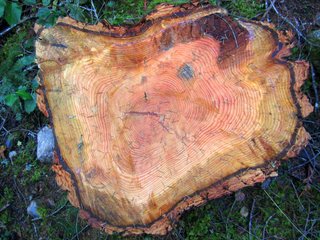
“The mountains are great stone bells; they clang together like nuns. Who shushed the stars?…Billions of stars sift among each other untouched, too distant even to be moved, heedless as always, hushed. The sea pronounces something, over and over, in a hoarse whisper; I cannot quite make it out. But God knows I have tried.
At a certain point you say to the woods, to the sea, to the mountains, the world, Now I am ready. Now I will stop and be wholly attentive. You empty yourself and wait, listening. After a time you hear it: there is nothing there. There is nothing but those things only, those created objects, discrete, growing or holding, or swaying, being rained on or raining, held, flooding or ebbing, standing, or spread. You feel the world’s word as a tension, a hum, a single chorused note everywhere the same. This is it: this hum is the silence. Nature does utter a peep – just this one. The birds and insects, the meadows and swamps and rivers and stones and mountains and clouds: they all do it; they all don’t do it. There is a vibrancy to the silence, a suppression, as if someone were gagging the world. But you wait, you give your life’s length to listening, and nothing happens. The ice rolls up, the ice rolls back, and still that single note obtains. The tension, or lack of it, is intolerable. The silence is not actually suppression; instead, it is all there is.

We are here to witness. There is nothing else to do with those mute materials we do not need… If we were not here, material events like the passage of seasons would lack even the meager meanings we are able to muster for them. The show would play to an empty house, as do all those falling stars which fall in the daytime. That is why I take walks: to keep an eye on things.”
Sunday, October 22, 2006

Bon appetit


Some ways God’s been blessing me this past week:

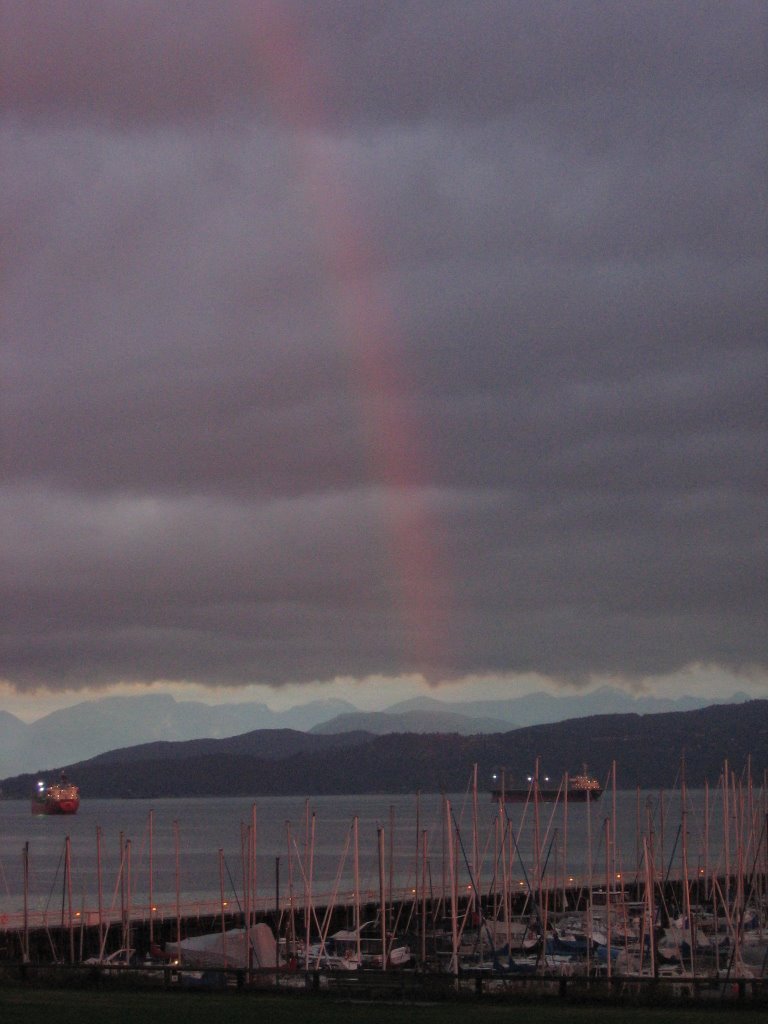
- Seeing a rainbow near my house during a brief break in the clouds.

- Getting to hold a 1-mo. old baby for an hour at my church.

- Watching a movie with a ten-yr.-old who wanted me to sit very close and cuddle her.

- Receiving a hug from a First Nations lady who I’d just met at Jacob’s Well.

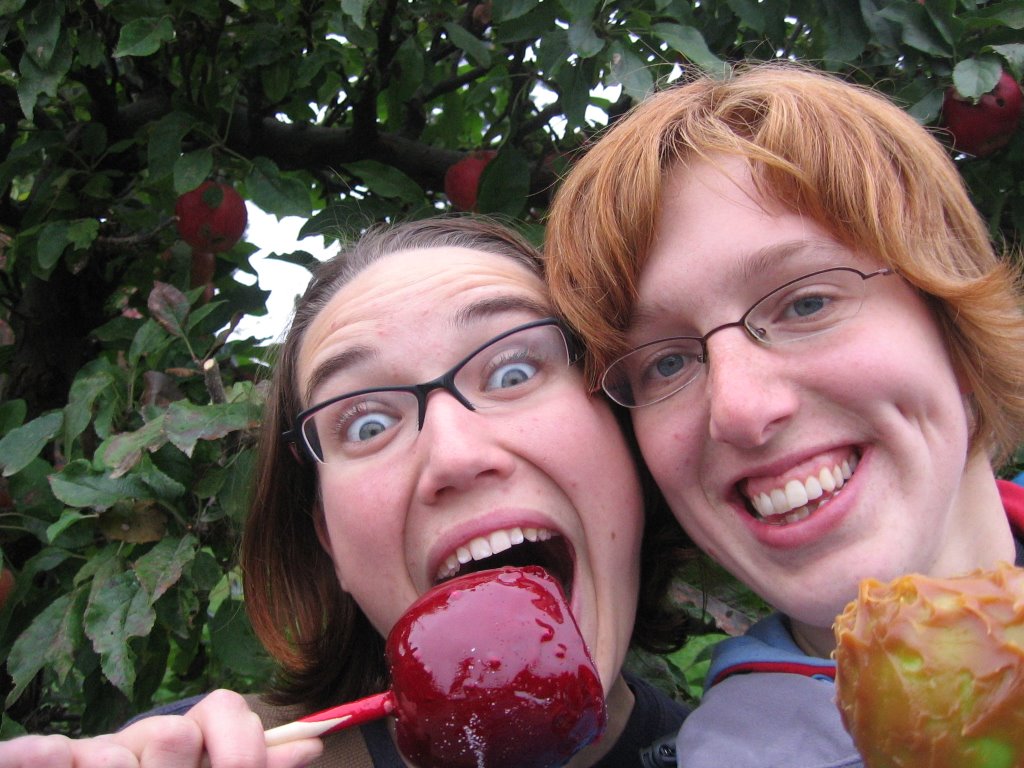
- Eating a caramel apple with Danice at the UBC Apple Festival. (She got a gross candied one...)

- Gifts of baking from two different people this week (I don’t have an oven!)

- Being called “beautiful” by two different men on the bus in the past two days. Both were definitely drunk and probably homeless (I’ll take compliments wherever I get them!) All I did to provoke these compliments was to say hi to them. Maybe saying hi makes you beautiful.

- Sharing excellent meals with two different groups of friends.

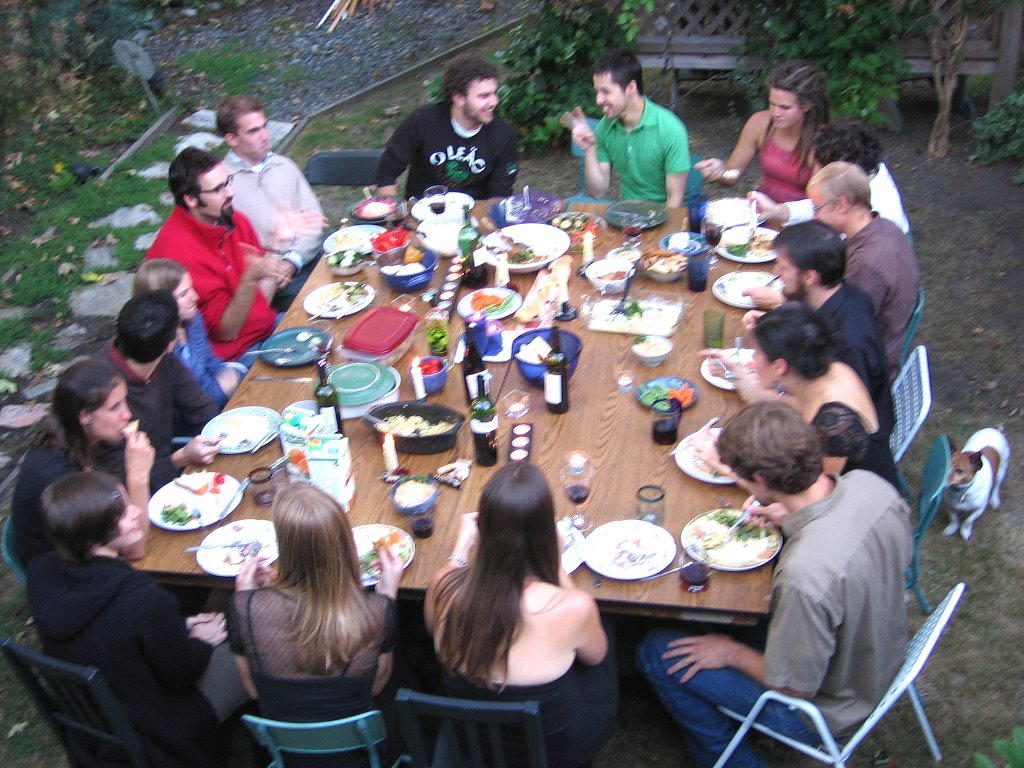
Let me expand on that last one. I grew up in a family that put a priority on eating together. This was so built into me that I took it for granted. Now that I’m away from family, I realize how deep a blessing it is to eat meals with other people. Eating by myself seems so much like filling up a car with gas – it’s just refueling of my body, and I don’t enjoy it nearly as much, even if I like the taste of the food. But eating with other people makes me feel very Kingdom-y. I’ve heard it said that community meals can be a way of announcing the Kingdom, so long as we’re welcoming everyone in and sharing what God’s given us… it’s a foretaste of the Feast we’ll all be sharing together one day.

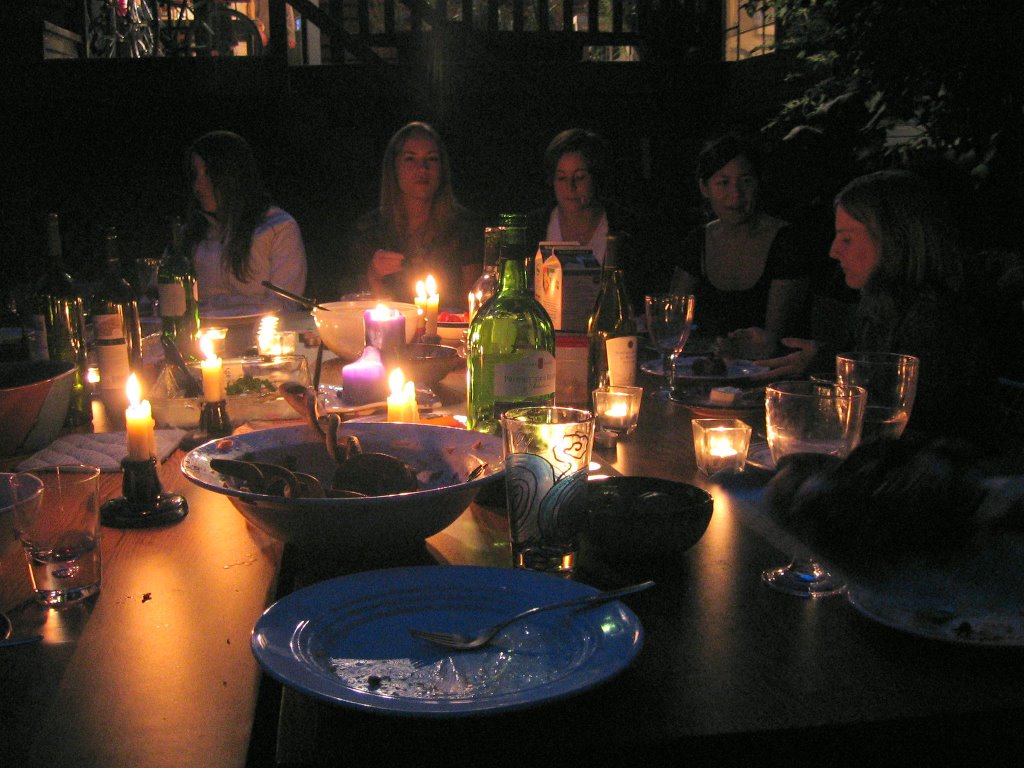
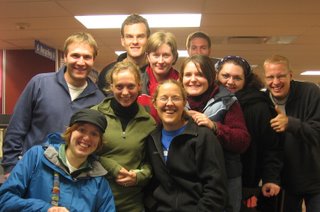
Since coming to Vancouver, I’ve heard (and used!) the word “community” ad nausea. But as much as the word is overused at Regent, I can’t say how important it’s been to find places to belong and people to share life with, especially coming from a big family. Fortunately for me, many of these communities love eating together. Jacob’s Well has harvest parties. Regent has Tuesday soup lunch. Kits church always has excellent post-service food. The photos are from a backyard dinner party Tora threw for a bunch of Regent students in September. My good old Wednesday morning prayer group has always included a sort of potluck breakfast. Lindsey Fox (who hosted the best meal I’ve had in months at her house last night) pointed out that “companion” comes from the Latin words “with” and “bread”, referring to the person you share bread with.

This is what I am realizing as I’m paying so much to learn theology… I need to learn a lot of other things besides theology to live the kind of Christian life I want to live: a life that’s closely tied to the earth and to community. These are things that don’t even cost money to learn. Things like gardening and wrapping presents and being hospitable and planning for long trips with people. And especially cooking. I have a poor track record with cooking… ask my siblings about the infamous wieners and beans fiasco a few years ago… These are all things I could have learned growing up with my mom, had I put more time and focus into them. Mom, I’m coming home for Christmas, and I want to learn more from you…

To end this post, I will be helpful and offer you some cooking tips I’ve picked up in the last month. Well, they’re not really about cooking, per se. They’re more about microwaving and condiments. They will show you that I have a lot to learn about REAL cooking. Here are my tips nonetheless…

1. Get this… you can make a baked potato in a microwave in under 7 minutes. I suppose it isn’t actually baked, it’s microwaved. But hey, in this oven-less house, that’s not bad. If I had known this microwave trick I would have had a lot more starch in my system last year. Don’t forget to poke a fork in them first, though. Fun fact: the Brits call these “jacket potatoes”, which I kind of fancy. Special thanks to Lindsey and her grandma for this tip. (And happy birthday Lindsey!)

2. Peanut butter is good on just about anything. Mostly ice cream. I rarely eat ice cream without mixing in a spoonful of peanut butter and chocolate chips and chocolate sauce. But I’ve also learned that it’s delicious on waffles (with syrup), sandwiches (my grandpa used to eat peanut butter and lettuce sandwiches) and rice cakes, and it’s funny to watch dogs and cats eat it. Special thanks to Danice for expanding my peanut butter horizons.

3. The piece de resistance… Frank’s Hot Sauce. This cayenne-pepper-based phenom is a welcome condiment on nearly any food. It is especially delicious on cheggels (cheese-egg-bagels) and in yaki soba. There’s something supernatural about it that blends into every flavor. Special thanks to our roommate last year, Bryanna, who had a bottle of this wonderful stuff in the fridge, which Danice and I would constantly use behind her back.

Well, I’m getting hungry with all of this talk of eating… time for some yogurt-covered raisins. I’m off to the Sunshine Coast tomorrow morning – I’ll let you know how sunshiny it is there…

Friday, October 20, 2006

Into Great Silence

I must start this post with a completely unrelated quote I just heard from my roommate Danielle: “What if the hokey pokey really IS what it’s all about? What if that’s all there is?” A sobering thought indeed.

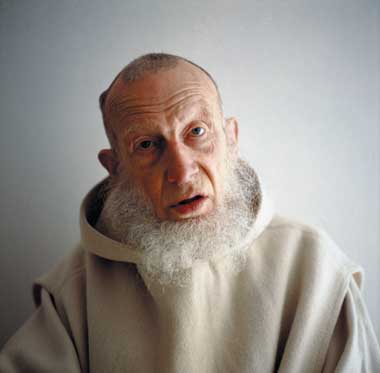
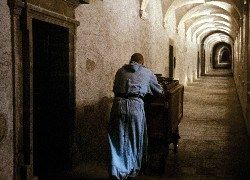
So the first movie I saw last week was called “Into Great Silence” or, in German, “Die Grosse Stille”. I saw it with Peter, who had been waiting for a long time to see it. The movie was part of the Vancouver International Film Festival, which I knew meant that it was going to be weird. I was prepared for weirdness. And I knew it would be about monks. Monks in the French Alps who take a vow of silence. I was all excited that I’d understand the French until I realized they wouldn’t be speaking…
So this was a very silent movie. A very long and silent movie. The person who introduced the movie said it would be calming, but at times I was a little TOO calm, if you know what I mean. After a long day at school, three hours of silence was difficult, and it felt like an accomplishment to have made it through the movie. No voice over. No background music. Only ambient noise. It’s crazy that these monks live this day in and day out. This is MDT solitude times a million.

I spent most of the movie in utter confusion as to how to feel. Should I admire these men, or pity them? Or some combination of the two? I’ve wavered in my view of the monastic life. Admittedly, these monks are among the most ascetic. Besides not being able to talk except on Sunday afternoons, they never sleep a whole night through. They sleep for three hours, wake up and sing chants for two hours, and sleep for three more hours. That has to be unhealthy somehow. There were some beautiful parts of the movie
, mostly in the rare instances when the monks had some contact with oeach other. A very old monk sitting shirtless, hunched over, the vertebrae in his neck sticking out grotesquely, most likely from the continuous bowing of his head, being rubbed gently with salve by a younger monk, in silence. An initiation ceremony culminating with each monk in the monastery embracing the new monk, and squeezing into his room to sing blessings over it. A Sunday outing where the usually solemn monks start sledding down the snowy hill on their feet, in their robes.

All in all, this movie didn’t make me want to be a monk – at least not a silent, secluded one. Not that I could be a monk, as a female. Hypothetically, though. In talks with Peter and Lindsey and Danice, I came to realize that I don’t think God put us here on earth to hide out in a building up in the mountains, out of the world, and just pray. Alone. Is that too judgmental? I know these guys have sacrificed their whole lives for this. But one thing I learned about last year is that in the Christian life, there has to be a balance between Mary and Martha – contemplation and action. Most of us outside of monasteries err on the Martha/action side. These monks were definitely erring on the Mary side. I think we need both. And I think we can’t know all of God when we’re isolated. We can’t know the relational part and the part of the kingdom that seeps through culture. And we can’t hope to do any kingdom-announcing work if we’re secluding ourselves from the people who need that message most. What do you guys think?

Aware of my Martha imbalances, I got wondering, what is the place of contemplation, solitude, silence, and simplicity in my life, outside the monastery? Incidentally, I have felt much more contemplative lately. I’ve been trying not to rush to fill my empty spaces with music, and I’m even trying to silence some of my inane mental conversations with myself to hopefully hear more from God. I’ve been feeling very much at rest most of the time (which Rachel says is equivalent with beauty). Except the last couple of days, which have been more scattered and difficult. But I’m going away on Monday, up the Sunshine Coast for a couple of days, so hopefully I can find an inner listening-to-God environment again.

If it be your will that I speak no more

And my voice be still as it was before
I will speak no more, I shall abide until
I am spoken for
If it be your will

If it be your will that a voice be true

From this broken hill I will sing to you
From this broken hill, all your praises they shall ring
If it be your will to let me sing
From this broken hill, all your praises they shall ring
If it be your will
To let me sing

If it be your will, if there is a choice

Let the rivers fill, let the hills rejoice
Let your mercy spill on all these burning hearts in hell
If it be your will
To make us well

And draw us near, and bind us tight

All your children here in their rags of light
In our rags of light, all dressed to kill
And end this night
If it be your will

(Leonard Cohen)

Saturday, October 14, 2006

Maybe I'm craaaaazyyyy...

I have three or four different things I want to write about, all unrelated, and all in different…moods. Some of them will have to wait.

Yesterday morning I came back from my Rock to find a great message on my machine. It was a 403 area code, so I thought it was my sister Sarah, but it ended up being Bob and Brandon Webber. (You may remember them from such posts as “Homowebmape” in May 2006). They were in Vancouver on a father-son road trip to see Sufjan Stevens in concert, and they wanted to hang out. And since they’re almost the closest thing to family next to my family, and I had a free night, I was thrilled.

So they picked me up and asked me if I knew of any restaurants nearby. I told them I don’t get out much, but I’d heard Regent students (and probably Danice) mention “The Naam” on 4th. So I accompanied these two Alberta farm boys to “The Naam”. (If you live in Vancouver and you’re more cultured than me, you may already be laughing). The waiter who seated us had a very thin, braided goatee. This should have been my first clue. We opened the menus. I scanned the menu items. Bob and Brandon were silent, with quizzical looks on their faces. “Wait a minute,” Bob said, “…where’s the beef?” He was right. There was no beef. And no chicken. And no pork. This menu was starting to look, shall we say, tofu-ey. Under the “Burgers” heading, there were veggie burgers and tofu burgers and veggie-tofu burgers. I looked more closely at the front of the menu. “The Naam: Vancouver’s Oldest Vegetarian Restaurant”. Yes, of all the myriads of eateries in Vancouver, I, Beth Malena, took two beef-loving Albertans to a vegetarian restaurant. We had a great time joking around with gravelly soldier voices: “Yeah, I was in ’Naam. I had the miso gravy.”

So yeah, it turned out fine. Then Brandon took me to a movie. (Incidentally, this is the second time a boy has taken me to a movie in the past three days… I’m becoming quite a player. I’ll tell you about the first movie next time.) We saw “The Illusionist”, which Jordan and Chris told me was good, and it was good. I came home and my roommates were watching “Speed”. I got ready for bed, and the boiler furnace thing, which is right off my room, made loud banging noises and I thought it was going to explode. My roommates assured me that if it exploded, we’d probably all die, but I would die the most. How reassuring. Thankfully it hasn’t yet exploded.

I tell you all this to set up my final story, which took place this morning, but likely very much as a result of the weird, mysterious, expect-the-unexpected sort of mood I was in. And it was slightly foggy, which also makes things feel more surreal. I was sitting on my Rock, looking out at the ocean, like I do every morning. I saw a seal, and then it dove again. Then it resurfaced, and I saw more seals pop their heads up – there must have been at least four. I’ve seen seals in groups before, but this was different. They were swimming around like crazy, and there were some things that popped up out of the water that didn’t fit. One of them seemed to have something white in its mouth, which I thought was a fish. There was so much splashing. And then something weird jabbed out of the water suddenly – I swear it was a human leg. I think I saw a foot. “Oh my goodness… the seals are murdering somebody!” I thought. Then everything stopped, as quickly as it started. They all dove down, taking this poor soul to their secret undersea lair, presumably to eat him. I have a lot more sympathy for people who think they see sea monsters. The ocean can be very confusing. I was seriously disturbed.

I thought about telling the people at the yacht club, but they probably already think I’m crazy. Some of them are usually working on (sitting on, looking really cool in) their docked sailboats when I arrive at the beach, and they see me stumble down the hill with grubby clothes on and messy hair (because I wake up and go to the beach without combing it), sitting on this big rock with my binoculars, occasionally dancing (thanks to the suggestion of a friend). I wonder if they have names for me. They probably call me “beachcomber”, because many mornings, like today, I spend the first 15 minutes of beach time picking up after the previous night’s beach partiers. It’s so aggravating. There must have been 30 beer cans this morning, a couple of them floating in the water, and those 6-pack rings that choke sea animals (though maybe the murderous seals need to be choked…). I always bring the cans to my house and leave them in the alley for the shopping cart guys in the neighborhood. Occasionally I glean more exciting things… like when I find unopened beer cans (I guess the party people are too plastered to realize they’re leaving beer behind) – I usually give those to Danice, because I hate the taste of beer. And this morning I found a Nalgene bottle, which I think was a gift from God because I don’t have a water bottle here. Sometimes my conscience gets to me, and I wonder if I should leave these things on the beach in case their owners return (my bottle has “Marina” written in white out on it…), but my logic is that I’m cleaning up their gross mess, so I deserve to keep whatever I find in it. Tell me if you think I’m wrong…or crazy.

Saturday, October 07, 2006

Stargazing


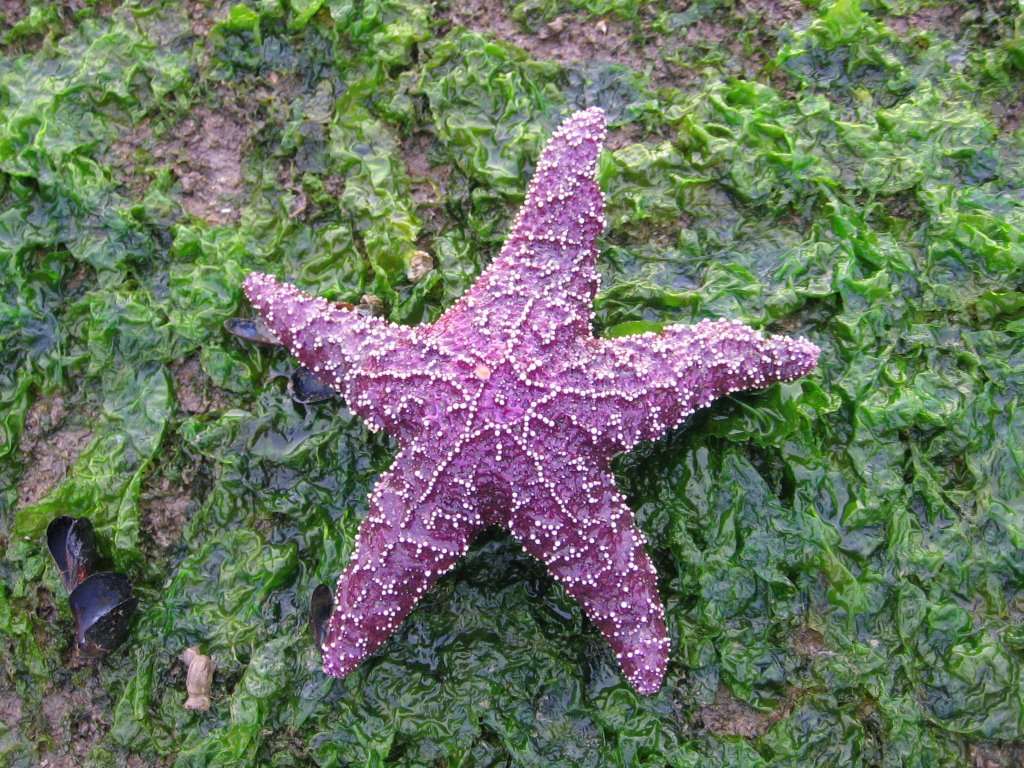
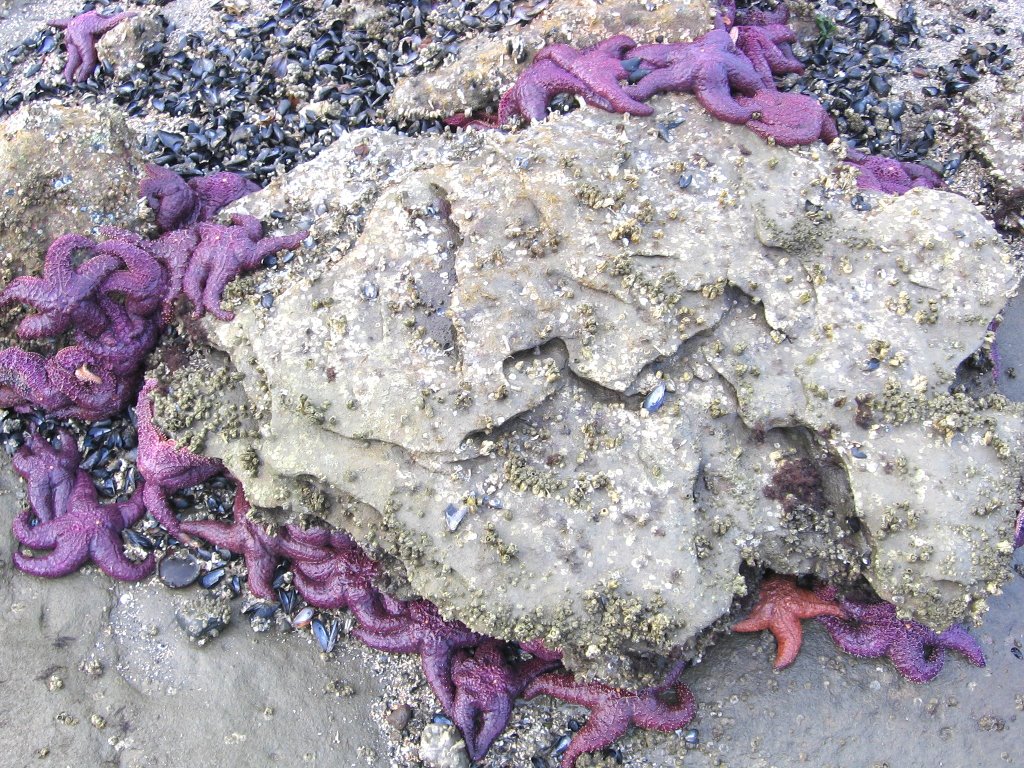
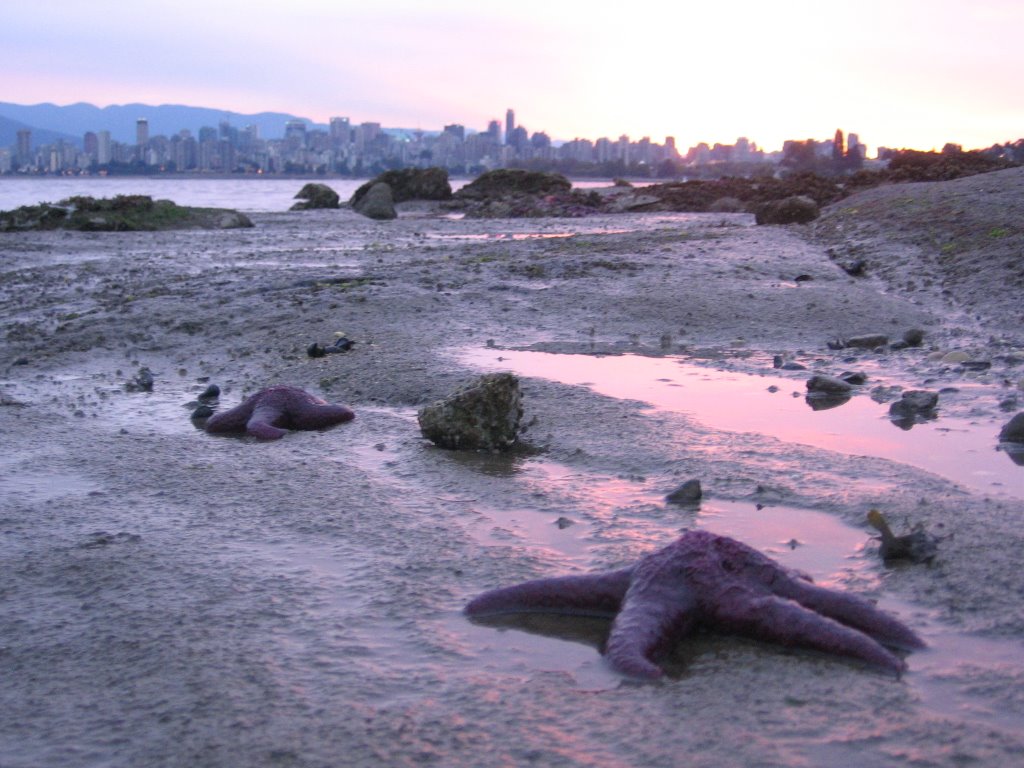
You may be saying, Beth, you have an obsession with starfish. Yes. I do. Well not really. I just like taking pictures of them, and watching them. Just think about these creatures for a second. Pretend you’ve never heard of them. Starfish are so surreal. They’re astonishing. Could you have imagined them up, had you never seen one? They’re just not logical. You couldn’t infer them from the rest of the animals you see. You couldn’t have predicted them.

I’m reading an incredible book called “Orthodoxy” by G.K. Chesterton, and it’s not about starfish, but he does say this, which I think applies (just replace “rhinoceros” with “starfish”): “It is one thing to describe an interview with a gorgon or a griffin, a creature who does not exist. It is another thing to discover that the rhinoceros does exist and then take pleasure in the fact that he looks as if he didn’t.”

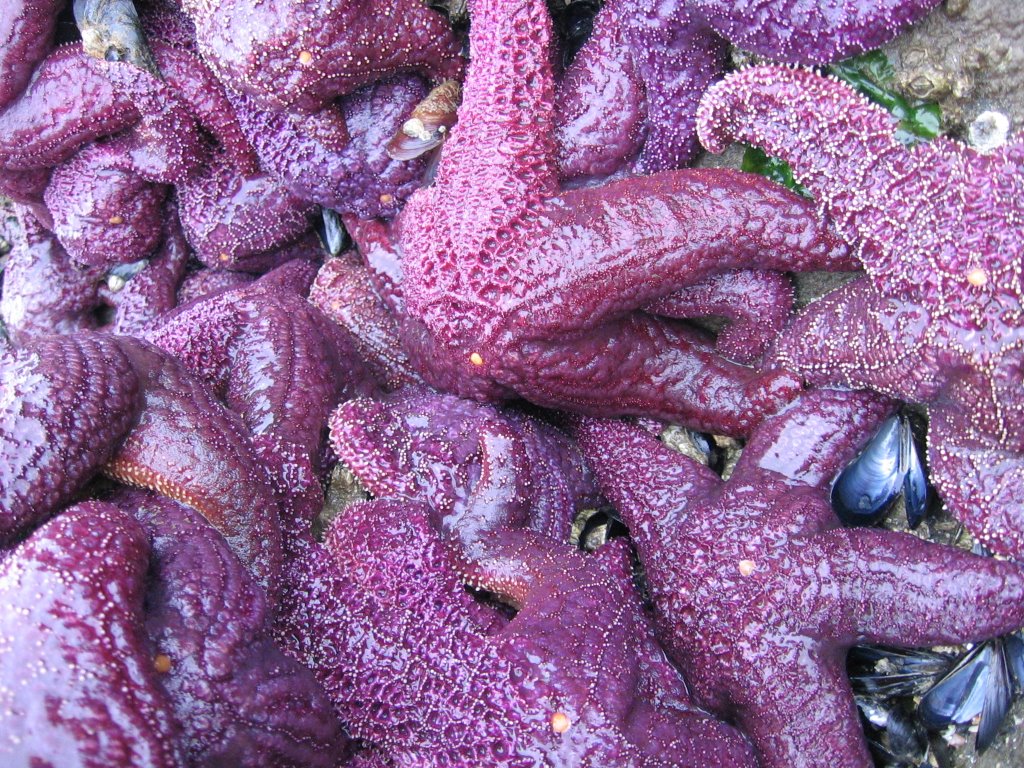
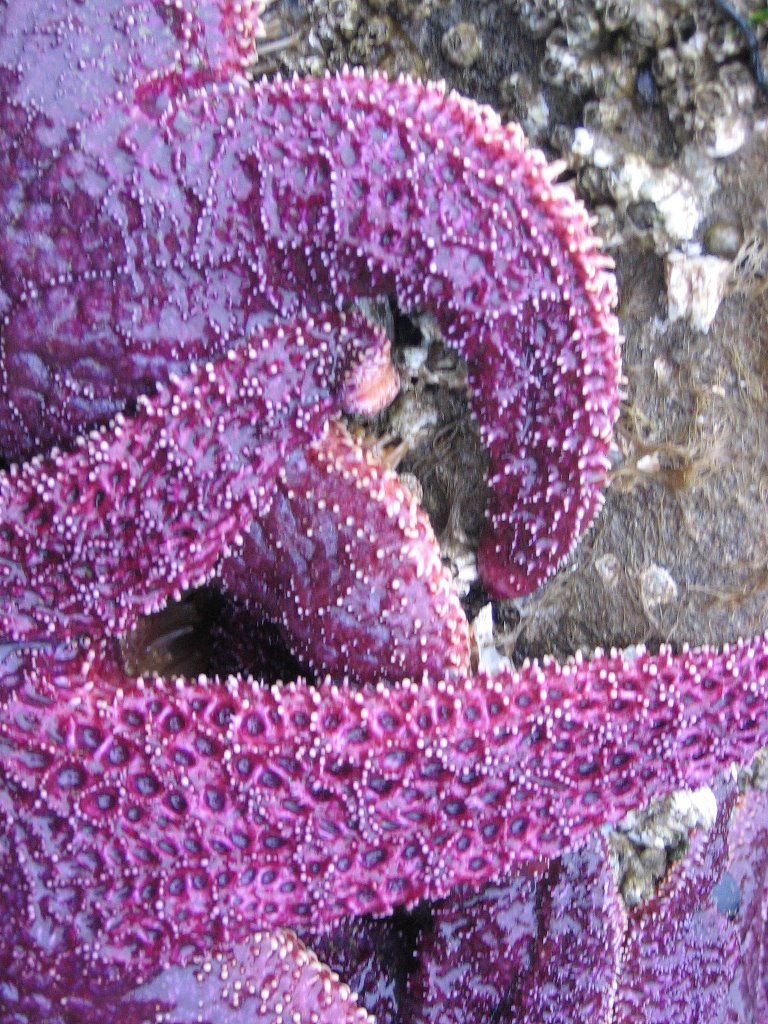
Their shape is too easy, as if it were designed to be readily identifiable when seen outlined in children’s coloring books. Their color could be used to teach the same children the meaning of “purple” – it’s so well achieved. The amazing number of tiny suction-cup tube feet on their underside seems like overkill – couldn’t a few big suction cups have done it? The tiny white ossicles on their back are perfectly placed, like constellations. Constellations on a star…that’s a paradox. They glisten in the sun, leading me to believe that they’re slimy, but really they’re hard and unbendable.

They lay there, all overlapped. I think some of them are extroverted and don’t mind, but others are probably really uncomfortable touching that many other seastars and can’t wait until they can move again. Because they can’t move when they’re exposed to air – they move by a hydraulic system, using their tube feet, and when they dry out, they don’t have enough water to work the system. They’re so vulnerable in low tides, immobile, stranded, clinging to rocks, waiting to be revived by the ocean. I walk around knowing I could destroy them all if I wanted to. It doesn’t seem right that some of the most beautiful things are also the most fragile and helpless.

It’s weird to think that they’re alive, since I’ve never seen them move. They seem like part of the rock. But if you try to pry one off a rock, you see how much power they have in their suction-tube feet. They really are like aliens. They eat things by inserting their stomachs into them. They can squeeze their stomachs into a 0.1mm opening in a mussel shell. They secrete fluids to digest their food before they swallow it. They have no brain, just a nerve ring. They have a pair of sexual organs in each arm. Wow.

Listen to this… it’s so brilliant… I thought this deep thought one morning at the Rock. Ready? The stars don’t like the moon. Seriously. Think about it. The moon is responsible for the tides. When the moon pulls the tide out, it exposes the starfish, and the seagulls start pecking at them and dragging them around and eating them. Which, I assume, they don’t like. Therefore they don’t like the moon. This is logical. Although the moon also re-covers them with water. So I guess it all evens out.

Okay, I’m done with my starfish rambling. I want to tell you about something equally geeky I have involved myself in. I have joined a club at UBC called “Friends of Wetlands”. Yes. The shorter form is “FOWL”. Mostly what we do is restore the Camosun Bog on Saturday mornings. This is a bog that is close to where I live, on the edge of the huge forest that surrounds UBC. If you don’t know what a bog is, you’re not alone. It’s much like a blog, but without an “l”. Just kidding. A bog is a place with wet, spongy soil, mostly covered with sphagnum moss. It’s very poor in nutrients. That’s why almost all carnivorous plants live in bogs (they get their nutrients from the insects they eat). The problem is that in the 1920s, people tried to drain this bog to build houses nearby. As a result, it got a lot drier, and a lot of invasive species moved in. We mostly weed them out to let the natural bog species thrive, like the sphagnum moss. It’s great. There’s usually people of all ages working in there on Saturday mornings, and we all have a tea break together, and I get to talk about plants and birds with people who like them as much as I do. And I’ve already had a few great conversations with UBC students who are intrigued with my “interdisciplinary biology/theology” master’s degree. The best part: I got a pin that says: “I’m a crazy bogger”. Ecologists are the wittiest people around.

Sunday, October 01, 2006

Of smores and labyrinths

Ok, first of all, this may not mean anything to some of you... but I have had a blogging epiphany, and it is called Firefox. I just downloaded it, and all of my blogging woes are gone forever. Blogger is a hundred times faster and more reliable in Firefox. I am in awe. I believe my father told me of the joys of Firefox, but I did not listen... oh, if only I could take back the hours of my life I wasted on Internet Explorer, waiting for a photo to upload only to find that it hadn't worked...what a waste.
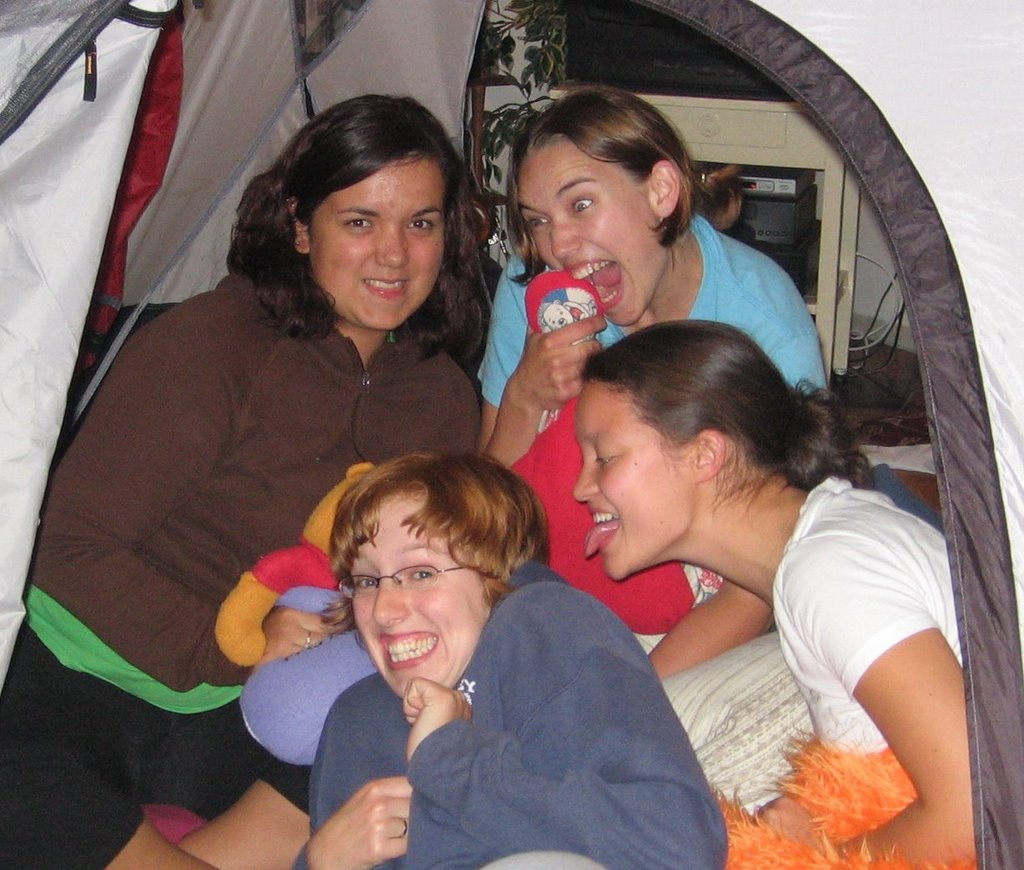
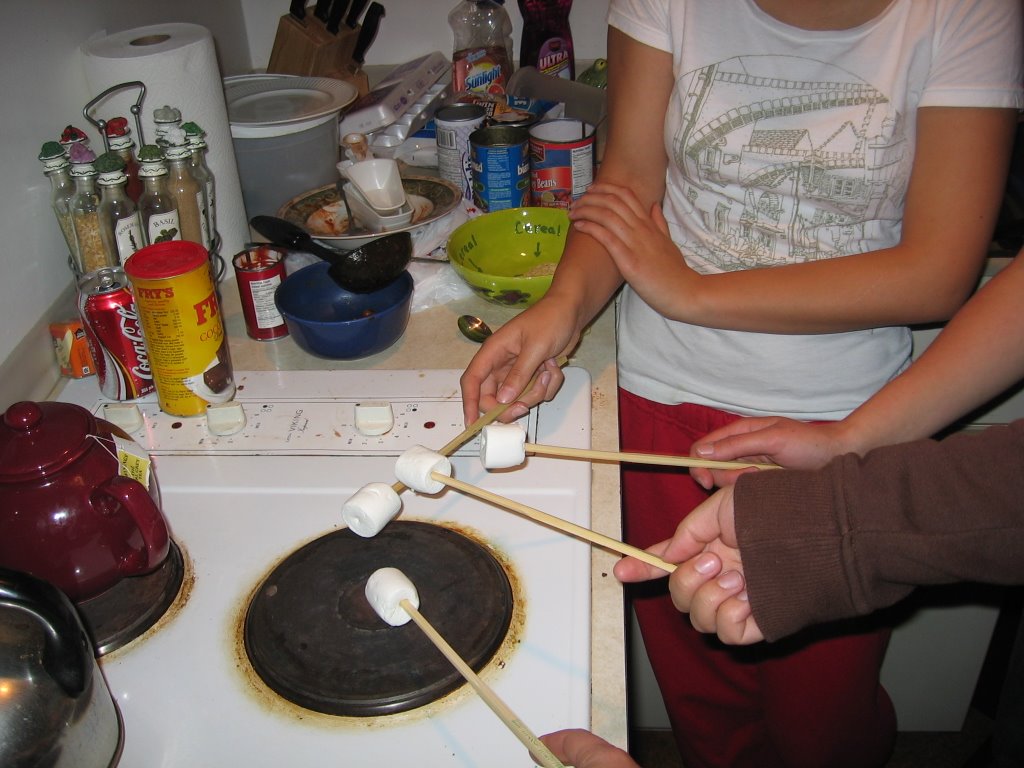
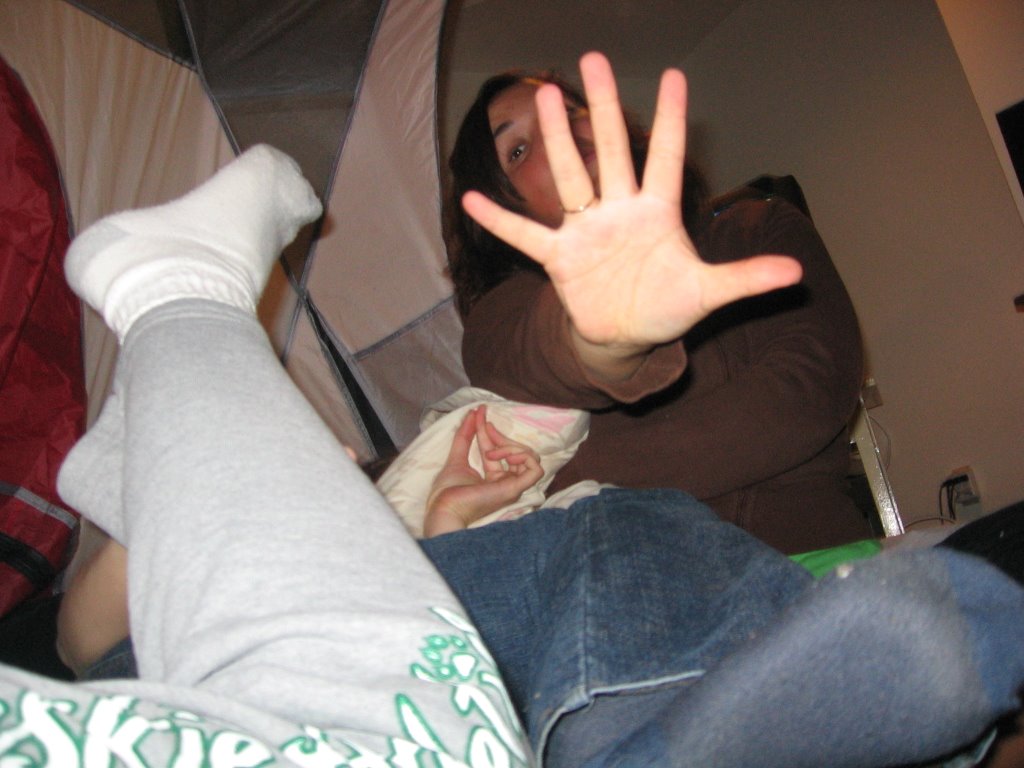
On with the real reason I'm writing... I need to introduce you to my housemates – my surrogate family in Vancouver. They look rather scary in this picture, but I assure you, they're not dangerous. Danice (dance with an “i” in the middle) you may remember from last year’s blogging. She is a fellow Regent student, studying to be the really incredible youth pastor that she already pretty much is. She dances like Michael Jackson. Danielle is studying liberal arts at UBC and mostly enjoys making time-lapse videos. I like stealing M&M peanuts from her jar. Lindsey is studying Native people and coordinating the production of a TV show about Aboriginal athletes. She makes me tea. All of them are from places close to Vancouver. All of them are lovely. We decided to celebrate our housemateness by having a camp night. In other words, Danice had to air out her tent, so we set it up in the middle of the living room.The best part of camp night was definitely the smores. We roasted marshmallows on chopsticks over the stove element (thanks to Tora for this idea!). We didn’t have graham crackers, so we used arrowroot cookies – you know, the ones that are always in the closet of the toddler room at church. We spent a good amount of time singing campfire songs. Actually, they were Beth-songs. Songs in which you replace a word that sounds like “Beth” with “Beth”. For example… “You take my Beth awaaaaay…” and “You’re simply the Beth” and “Baby boy make me lose my Beth” and “Every Beth you take”. It’s a good thing that so many songs can become about me, because if you’re trying to write a song about me, I warn you, my name is very hard to rhyme with anything. So far, the only rhyming words for “Beth” I’ve thought up are “breath” and “death”. And, as Jared so helpfully pointed out this summer, “crystal meth”.
After a brief but vicious pillow fight, we put the tent to good use by laying in it and watching a movie through the door. The movie was Labyrinth, a movie from Danice’s childhood. I’m sure glad I didn’t watch this movie as a child. The title should have been “Some very disturbing Muppets with an even more disturbing David Bowie”. David Bowie was the King of Goblins, but mostly he wore tight pants and sang something like “Dance magic dance”. I am scarred for life.

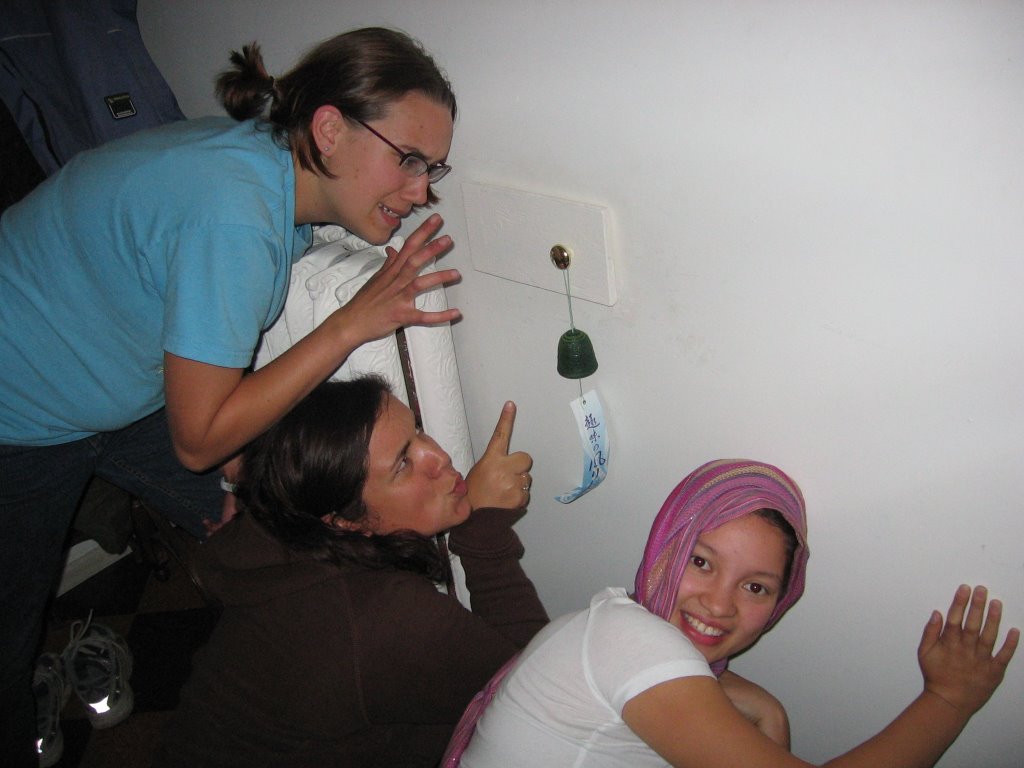
For those of you who are worried about the possibility of more rats in my house this year, I wanted to show you this picture to reassure you. Our landlords built this lovely little door to cover the hole in the wall where Melba the rat enjoyed entering our basement. Unfortunately, the door is secured by Velcro. I surmise that a rat who had the sense and strength to chew through packing tape and Tupperwar
e last year could push open a Velcro-ed door this year, if it didn’t chew through the door itself. So when I received a decorative bell as a present from my Japanese friend Toshi, I decided to hang it on the mini-doorknob, so that when the rat pushes through the door, we will at least be aware of its presence.
In other news, I’ve had a weird day...Lindsey and I were riding the bus to church, and all of a sudden, two cars smashed into the side of the bus. I think they ran a red light. I don’t think anyone in the cars was seriously hurt, but one guy was bleeding from his head. It shook us up pretty badly. We walked the rest of the way. Then, at the beginning of the church service, an elderly lady fell over after tripping, and an ambulance was called. And after the service, I was talking to a friend I’d met at the church last year, and I asked about her roommate, and she told me that he died suddenly, two weeks ago, after falling during a hike. All of this within a 3-hour period. I’m not sure what God’s trying to say through all of this, but all day I had a craving for the familiar and the safe. Luckily I had Jodi this morning and Rikk at Rock Garden, not to mention supper at Lindsay's, to bring some sanity back into my life. Also, I got to spend some time with Lisa Nazarenko tonight, which briefly satisfied my desire for familiarity and for Ukrainians, who I've grown to love. Sometimes I wish I were one of them... but my name would have to end with an "a". Betha. Bethica. Oh well. I think you've seen my name enough for one blog...

Thursday, September 28, 2006

Looking down the Well


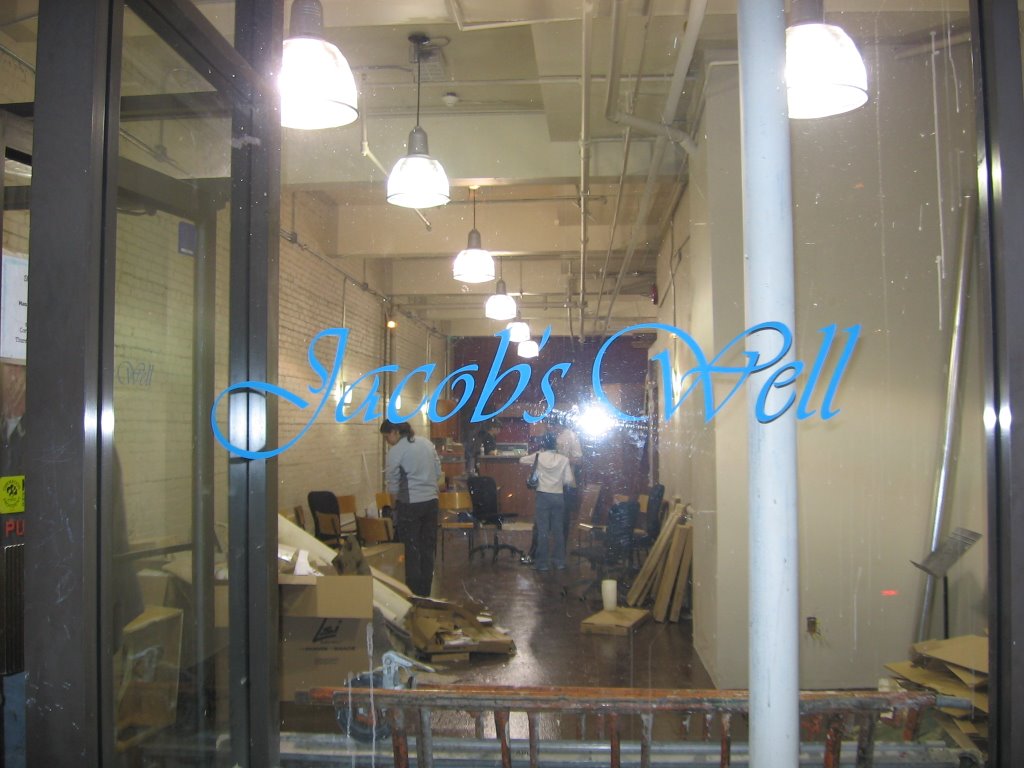
Well, it’s about time I wrote about Jacob’s Well, because it’s become a rather important part of my growth and learning here in Vancouver. Jacob’s Well defies definition in a lot of ways. It’s not a soup kitchen, although we do a lot of eating there. It’s not a shelter, although we hang out in the building a lot. It’s a place where I volunteer, but more accurately, it’s a community and a family I belong to. Words like “community” are over-used, but really, if ever there were a ministry that lived up to its mandate of being “relationally-driven rather than program-oriented”, it’s this one.

In case you haven’t heard about the Downtown Eastside, the neighborhood in Vancouver where the Jacob's Well storefront is located, let me fill you in on a few statistics (stolen from a talk I’ve Joyce Heron, the director of Jacob’s Well, give many times)… it’s the poorest postal code in North America. 16 000 people live in this 5-square block radius, mostly in SROs (single room occupancy), which are 10x10 foot rooms, usually in old converted hotels. The Jubilee is an SRO above Jacob’s Well, where 80 people share about 5 washrooms and 2 kitchens. Over half of the Downtown Eastside residents are mentally ill – this is 18% of all mentally ill people in BC, in one neighborhood. Out of the total 16 000 people, about 10 000 are drug users, and 5000 are needle users. 37% have AIDS, 67% are HIV positive, and 92% are Hepatitis C positive (also a terminal illness). This is the largest health pandemic in the Western world. By concentrating SROs and welfare systems in the Downtown Eastside and policing less aggressively there, the city is trying to contain it to one neighborhood. The Downtown Eastside is also a neighborhood with 84 non-profit organizations, of which a third are faith-based. You can get fed seven times a day, and more when Christians walk around at night passing out sandwiches.

So what do you bring to a place like this where people are already being fed and clothed and told the Gospel, but infection and addiction and death tolls are still rising? The idea at Jacob’s Well is that the method is as important as the message. The people at the Well see no biblical mandate to save or fix people – only to love them. As friendships develop between Downtown Eastside residents and volunteers at Jacob’s Well, as we live the everyday Christian life around them, and as we both serve and are served by them, God’s kingdom is announced in a powerful way. I feel privileged to have seen this in action, and to be continuing to learn what it means to follow Jesus’ example in being not a friend TO but a friend OF the poor.

In practical terms, this can look very different from day to day. Some volunteers help lead a worship service on Monday nights. Others join in Tuesday night community kitchen, when some of the 80 people who live above Jacob’s Well come down to buy food, prepare a meal, eat it and clean it up together. Wednesdays are usually days when volunteers tend the plots of land we’ve converted to community gardens. Thursdays and Fridays (I’m on the Friday team) are days when we visit friends in the hospital, deliver food to disabled members of the community, and open the storefront for coffee for whoever wanders in. We have a party every month. I have done many things on Friday afternoons, from cleaning bathrooms to baking muffins to playing guitar at the funeral of a man I’d never met, attended by five people.

There is much more I can and will eventually say about Jacob’s Well, but I wanted to post a copy of an article I wrote for their newsletter a couple of weeks ago. Visit http://www.jacobswell.ca if you want to learn more. Here’s the article:

Several months of volunteering at Jacob’s Well on Fridays have taught me to expect to be asked to do new things. Last week, as Joyce, Berto and I donned blue hospital gowns and latex gloves, preparing to enter a room in the intensive care unit at Vancouver General Hospital, I realized I was embarking on another unique experience.

Our friend Nicolai was in that windowed-in room, recovering from a back injury. When we walked in, I expected him to greet us right away, but all I heard was the electronic music of the many monitors attached to him. Then I saw the tube in his throat that robbed him of speech. Of all the people to lose their voice, I thought…

Nicolai’s voice scared me the first time I met him last year, when he wandered into Jacob’s Well, yelling loudly in his Eastern European accent. When he returned the next Friday, I remained wary of him. The other staff seemed relaxed around Nicolai, and asked him to play a song on his harmonica. He plucked it from his jacket pocket and obliged, and we clapped along. I noticed him repeating phrases he had spoken the previous week: “I’ll see you when I see you” and “So far so good,” among others. The last of my fears melted when he sang “Pretty Woman” with twinkling eyes and a mischievous smile. Later, I became a contestant in his favorite game: guessing the capital city of any European country he named. He had them all memorized. I did not. I failed miserably. (A tip in case Nicolai asks: the capital of his home country, Bulgaria, is Sofia.) As the weeks passed, I improved at the game, and gradually the voice I had feared became a voice I hoped to hear in the doorway.

But in that unfurnished and profoundly lonely hospital room, I barely recognized Nicolai. I had never seen him clean and shaven; his skin was a new colour. His old blazer and cane were hidden somewhere, replaced by a white gown. It made me uncomfortable to see this calloused, gruff man so vulnerable; I had a strange urge to cover him back up with his familiar stubble and dirty clothes.

Nicolai mouthed words to Joyce, the best lip-reader in the group, asking her to scratch his head. She did, with her latex-gloved hand. Sudden childhood memories surfaced; I recalled my father rubbing my head to help me fall asleep. At that moment, eyes closed and smiling, Nicolai seemed just as childlike as I had been. I couldn’t believe I had once feared this man. “Nicolai,” Joyce said, “they usually only let family members visit patients here. We told them we had become your family down at Jacob’s Well, and they let us see you.” Still rubbing his head, she told Berto and I how she and Nicolai had met at a bus stop, how he became part of the Jacob’s Well family. Nicolai interrupted often, mouthing out his own memories, visibly proud that his story was being shared.

Joyce suggested we sing, so we sang “Great is Thy Faithfulness” for Nicolai. As the familiar lyrics left my mouth in a shaky harmony, I wondered whether I would trust God’s faithfulness if I were in Nicolai’s place. Did Nicolai know God’s faithfulness? Would our visit communicate it to him? Would he understand our love?

We prayed together for God to bring him wholeness and peace. The room seemed less lonely and cold than when we had arrived, and Nicolai was calm as our visit ended. He told us not to worry about him. We assured him that we would, and that we’d keep praying. We said goodbye.

“I’ll see you when I see you,” he mouthed to us, with that familiar mischievous smile.

Thursday, September 21, 2006

In defense of staying put

Permit me another entry in a similar vein to the last. Let me first tell you about the event that spurred this thought – another close encounter with the sea otters this morning. At the first sign of them, I was off my Rock, running to the water’s edge, my binoculars bouncing against my jacket. Three of them again – the same three? I realized what’s so eerie about them – every time they surface, they’re looking right at me. Seals turn their heads a lot, looking around in every direction, but the otters fixed me with their eyes, and seemed to express both an annoyance that I was there and a challenge or taunt for me to chase them. I followed them until they went under the bridge, and then, surprisingly, they sauntered out of the water onto the land under the bridge! I watched their silhouettes as they slunk around in the dark, secretly fearful that they’d run out and attack me. Then they slipped back into the water on the other side of the bridge, and I ran around to watch them for several more minutes. And get this – I did some research tonight, like the geek that I am, and I discovered that they are not sea otters! They are river otters, despite the fact that they hang out in the ocean. Sea otters live further out and rarely come on land, but river otters, which live in fresh and saltwater, spend 2/3 of their time on land. They can also hold their breath for eight minutes…

So for those of you I haven’t lost in my biological ravings, here’s the deep philosophical thought I’m getting to… part of me really doesn’t want to travel much. Part of me wants to stay put until I know a place. And how long does it take really know a place? Last year I sat on the same rock down at the beach just about every morning for seven months, which is about 210 days. This year I’ve returned the last 14 mornings, and in that short time I’ve seen three kinds of animals I didn’t see last year (including the river otters, and one tiny bird unfortunately called a bushtit… Chris has renamed them t-cups). The place I thought I knew is now surprising me again.

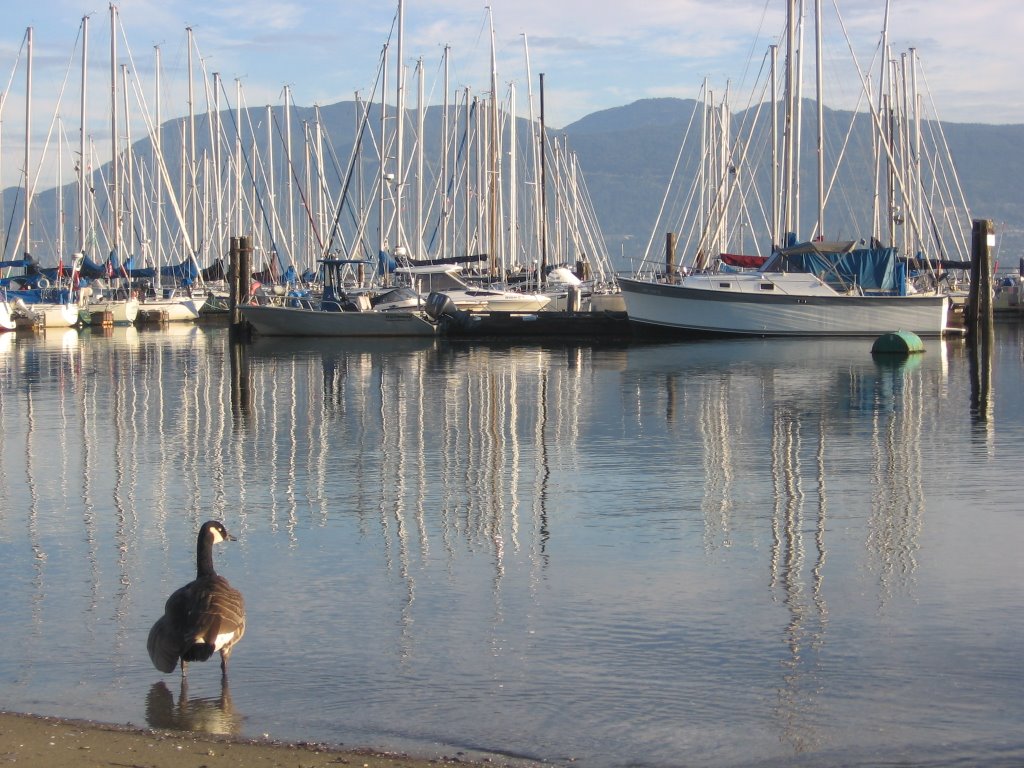
When will I know it? Every time I successfully make it down the steep and often slippery hill, I stand at the entrance to my “land” and survey it for a minute, forcing myself to notice the uniqueness of the scene every day. This place changes with the seasons, as the leaves change color and fall. I have never seen it in the summer. I saw it snow-covered only once. It looks different depending on the tide level. Sometimes I sit on the Rock and look out at a vast landscape of barnacle-covered rocks scattered with purple (ochre) starfish, and other mornings I have to jump on the Rock from behind because the ocean is covering the front of it, and all I see is water, and it slowly recedes as I sit there. The water holds the most secrets - I never know what will surface next - and it is also the biggest variable. Depending on the weather, it can be a gray, frothy mass or an expanse of still blue glass, or anything in between. The weather also changes the appearance of the mountains in the distance, and the strength of the wind affects how many seagulls are out and how many of the sailboat masts clink together.

I experience the place in a different way when I’m in a bad mood than when I’m afraid or when I’m at peace. I have yet to sit there for a long time with a friend. That would change things for sure. I have yet to bring a dog, like the majority of people who visit the beach. Maybe the dog would make me see it in a new way. And I have yet to sit there in the middle of the night. So I guess I don’t really know it. There is plenty left to sound the depths of, plenty of hidden parts to uncover and layers to peel back, things to experience there, things to delight in. Will God ever exhaust all ways of surprising me with joy there? And if I do ever really know it, will I get tired of it? Will I want to go somewhere new? Suddenly I feel like I’ve been talking about marriage…

And when do you own a place? When does it become yours? A lot of times I treat my Rock and surrounding area as my own. When people walk past me, I usually feel like I’m graciously allowing their passage through my territory, even though they don’t realize it’s mine. Why do I feel such a sense of ownership? It’s not a selfish ownership – I never lose the sense that it’s a gift to me, and a gift to be shared. But I get upset if there are beer bottles lying around. Sometimes I pick them up. And I feel that things I see were set up for my seeing. God speaks to me there. I guess I love it. I just remembered a passage in Brian McLaren’s book “A Generous Orthodoxy” that says it much more eloquently:

“I feel that I am carrying around this hilarious secret: that I actually own all things, that all things are mine – because I am Christ’s, and Christ is God’s, and God allows me to have things in the way that matters most. Not by having them in my legal possession (which has many downsides, including upkeep and taxes!) but by having them in my spiritual possession by gratefully seeing them, gratefully knowing and cherishing them. Those weren’t legally my goldfinches or my sycamore trees or my rocky-bottomed streams in the park that day, but did anyone on earth possess them as fully as me that day?”

Sometimes I’d rather think thoughts like this than study Hebrew, even though Hebrew can also be frustratingly beautiful. Which leads me to a closing quote by Bruce Cockburn (this one’s for you, Chris)…

“All these years of thinking ended up like this: in front of all this beauty, understanding nothing.”


Saturday, September 16, 2006

Surprised by beauty

I wanted to post some pictures and thoughts that began in our post-wedding trip to Banff and Lake Louise. I realized something on our first day, when we took the gondola up the mountain: I have trouble taking pictures of - and even fully enjoying - things that have already been recognized by the general public as beautiful. If there’s already a postcard of it, I don’t feel like taking my own picture. On top of that mountain, I found myself lamenting that it was all so already-discovered.
It’s like beauty isn’t as beautiful unless you chance upon it, the way Daniel and I chanced upon this tree. I remembered Sophia’s story about the old church she found in the middle of nowhere, and the way Chris got excited every time an unannounced storm appeared on the horizon, and how Claire stopped by the side of the road to take pictures of cows. Part of the beauty of these things is that we were not prepared for them – they caught us by surprise and bowled us over.
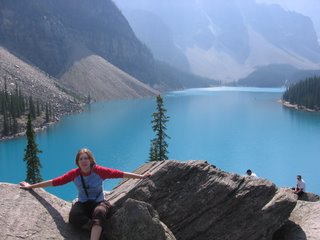
I guess I’m not a fan of crowded, expected, publicized beauty. I want beauty new, just blossomed, fresh fallen. I want to be the one to find it and name it beautiful. I don’t mean to sound ungrateful – the boardwalks and stairs and gondolas were great, but they stole something, something private between my Creator and I. They stole that moment when hidden beauty is revealed and we delight in it together.
I heard a story about a scientist (I’ve tried for hours to figure out what his name was…) who was poring over his research on DNA, late into the night, trying to figure out something to do with DNA structure. After hours of thought, it suddenly came together in his head – he had discovered the secret and cracked the code! But instead of calling all of his scientist friends to share the news, he just sat there for the rest of the night. When his friends asked him why, he said, “For those hours, only my Creator and I knew this secret. I wanted to savor it with Him.” For the briefest of moments, after hearing this story, I wanted to go into research.
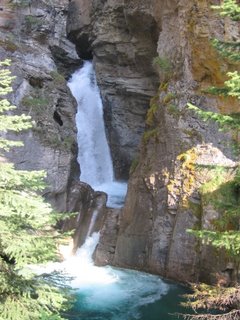
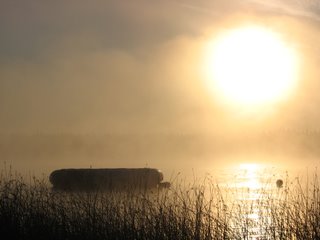
Until I realized I didn’t have to be in research to experience this. For example…the other day, early in the morning, I was down at my Rock alone, watching a few ducks and a goose splashing in the ocean. Then, in unison, they all calmly stepped onto shore and stood there. I felt like they knew something I didn’t. Full of anticipation, I looked out at the water, and sure enough, there were three heads poking out over the surface of the water. They looked like beaver heads, but beavers are freshwater animals…no…they were sea otters! The first ones I’d ever seen in the wild! I think I shouted something original like “Sea otters!” and took off running down the beach, chasing them along the shore. They dove and surfaced again, snorting water through their whiskers. I saw one catch a fish and eat it. They saw me – they seemed to look right at me and extend their necks far above the surface. I was in awe. At that moment, only God and I were enjoying those beautiful, playful animals.

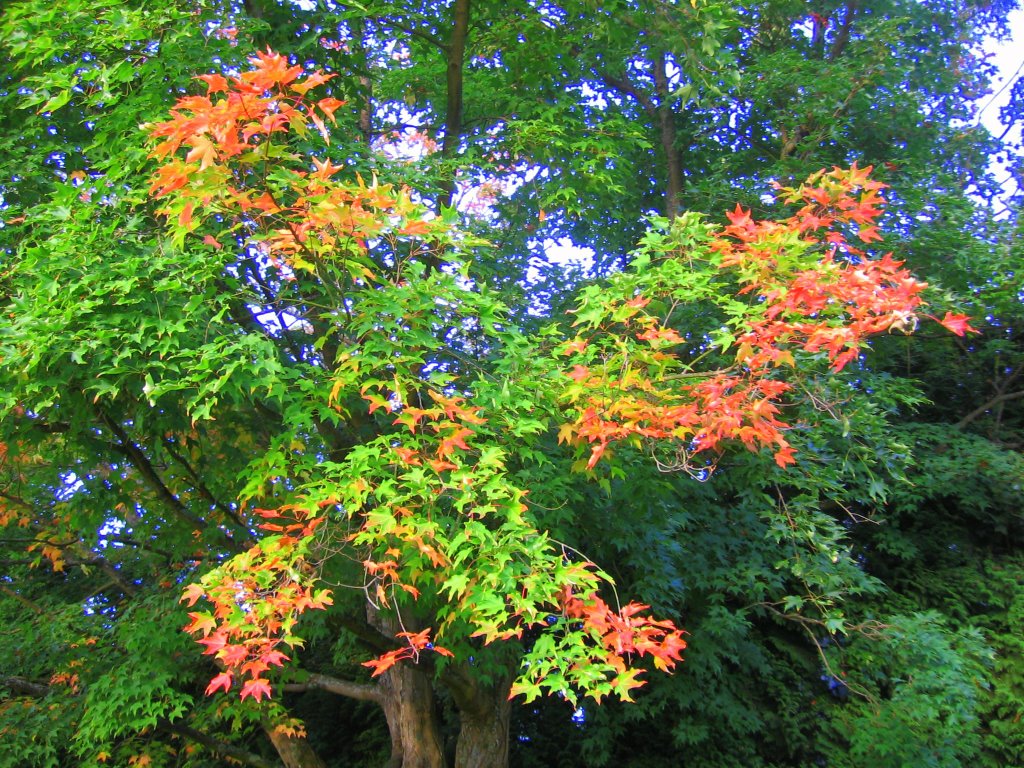
Later that day, this group of leaves just popped out of a tree at me – all red and yellow, they seemed to be on fire, lit up with colour, like a signature. Again, I wanted to burst into song. These are my favorite moments – I’m sure they’re happening all the time, and I miss many because my eyes aren’t open wide enough. They’re why, whenever possible, I have my quiet time with God outdoors. I’d like to think He draws sea otters and leaves on fire towards me, placing them in my path, and then whispers, “Here, Beth. I want to share this with you – let you in on this secret. I want you to share my delight in this. My gift to you…”

Loren Wilkenson, my prof for “Christianity and Science,” read us a quote by E.O. Wilson, where he wishes God would take him to a new planet so he can spend years just discovering and exploring and being the best kind of scientist. I’m more optimistic. I don’t wish – I am confident – that this will be my experience when God makes the new heavens and new earth…I will spend eternity in endless discovery, with beauty always fresh and waiting, and hundreds upon thousands of secrets to be shared.

Friday, September 08, 2006

From one familiar to another

One thing about living here is that it forces more space into my life. I have to take time to walk to the bus stop, to sit on the bus, to buy groceries, to cook food, to wait for our slow kettle to boil water for tea… all things I didn’t have to do in Saskatoon. Space is good but it tends to foster a lot of thinking.

So during these spaces, I’ve been trying to sort out how to describe my state of mind in the last few days. I’m generally content, occasionally excited. I haven't cried at all yet. But I have felt a little... strange. Maybe my problem is that I flew. Sam and I once discussed airplane travel, how you jump so quickly from one bubble into another and don’t get the sense of distance. That’s what happened to me. I jumped from one familiar into another familiar, and it’s jarring, like skipping from one plot line to another. From a lake to an ocean.

It doesn’t feel like it did last time I arrived in Vancouver. Then, it was new, dazzling, something to get used to, something to feel my way into. Now, it feels too normal to live here, too easy to slip back into. It’s little things that haven't changed…like the fact that we still don’t have enough spoons. Our living room is still cold and my room is still hot. We still have the crazy patterned rug on the floor from whence nothing dropped shall ever return. One of our bathroom sinks is still plugged and drains slowly. The number 4 bus runs on the same schedule as before. My rock is still there, and the seal, the heron, the kingfisher, and other friends have already stopped by to welcome me back. Talking to Chris on the phone, with plenty of silences – that felt familiar too. My Regent friends, my Jacob’s Well friends… they’re here, and they don’t seem to have changed much. It feels like I’ve jumped back in time to last April, and this whole entire summer was just a brief dream I had one night.

Maybe that’s why I keep forcing this summer back into my mind. Forcing faces to appear, half-believing that person sitting in front of me on the bus might be Rachel, or Chris, or Robin, or Sophia or Lesya or Olya or Terice or Claire. Remembering them and praying for them. And I’ve been reminding myself that even though Vancouver feels familiar, I am not the same as I was in April. It was no dream - I have had experiences and conversations and developed relationships over the summer that have changed me and caused me to discover new things about myself, hopefully for the better. The old Vancouver will have to catch up to the new me. And I will have to keep learn that my identity is not tied to where I am but to whom I belong to. I will have to work to love people, near and far. It will be a difficult and sweet adventure.


Here is my paradox: can I really have two homes, Andrea? My soul is more tied to Saskatoon than ever and my soul is more at ease in Vancouver than ever. I knew I was missed and loved in Saskatoon, but now I return to find I was missed and loved in Vancouver, too. This brings me a melancholy combination of pain and joy no matter where I am. Each “glad to see you again” is counterbalanced by an “I wish you hadn’t left”. If one of you had the chance, you might tell me to stop living with one foot in each place. I don’t think I can help it.